Monday, March 5, 2018

A Sense of Urgency, A Sense of Hope – Our Latest Paper on Continuous Improvement for Health & Care

We’re delighted to announce the publication of A Sense of Urgency, A Sense of Hope; our latest paper by our Chief Executive David Fillingham CBE and Director Lesley Massey exploring how organisations can develop and support a culture and system for continuous improvement.

In the paper, David and Lesley take a look at recent best practise, changes to the health and care landscape, and distil over eight years’ experience of working with members as the North West’s quality improvement body, into five key domains where organisations can support and invest in a quality improvement system:
  • Vision
  • Leadership & Culture
  • Capability
  • Developing an Operating System
  • Aligning Support Services


Speaking on its publication, David said:

“We’re really excited to share our new paper, and hope it offers our colleagues across health and care an in-depth framework to help support their aims for continuous improvement.”

“Whilst we recognise the extreme pressure the NHS and wider care sector continues to face, we feel it’s important to still look for a light at the end of the tunnel. Therefore it is vital organisations invest in improvement, if we are to meet the demands of better, more efficient care and improved outcomes for patients.”

“We really believe this is possible and as we highlight throughout the text, there are a number of organisations we can look to for inspiration to achieve this together.”

Throughout the paper, the pair also look at case studies from our work with members, including from: Aintree Hospital NHS Foundation Trust, Manchester University NHS Foundation Trust, Mid Cheshire Hospitals NHS Foundation Trust, North West Boroughs Healthcare NHS Foundation Trust.

Other examples also point to leading improvement organisations from other industries and sectors outside of health and care.

The paper was recently launched to over 100 delegates at a joint event with The King’s Fund; exploring successful approaches to quality improvement. Following the event, co-author Lesley Massey said:

“At the event delegates gave us some fantastic feedback on the framework and each of its five domains.

“We’re now developing a self-assessment diagnostic to support the framework, and would welcome interest from colleagues across the country who would be interested in testing this.”

If you would like to request a hard copy of the paper, or are interested in testing the self-assessment diagnostic, please get in touch via AQuA@srft.nhs.ukAlternatively, feel free to share your thoughts with us via Twitter @AQuA_NHS.

Friday, February 23, 2018

Blog – From Patient to Practitioner – My Lived Experience of Working with AQuA – Carl O’Loughlin

Carl O’Loughlin has been a member of AQuA’s Lived Experience Panel since 2015. As he starts his training to become a qualified mental health nurse, he shares his experience of working with us for the past three years.

Carl O'Loughlin
I first came into contact with AQuA in June 2015, when I was working as an involvement representative on a peer support project in the Cheshire and Wirral Partnership NHS Foundation Trust (CWP). Through this project I met Paul Greenwood, AQuA’s Mental Health Improvement Advisor; who was running a Restraint Reduction initiative on one of the CWP inpatient wards.

During our meeting, I shared with him my work with CWP, together with my own lived experience of using mental health services and my professional background; where I had experience of quality improvement.

Paul also told me that AQuA was forming a Lived Experience panel and after applying to join this and an interview, I was pleased to be offered the role as one of five Lived Experience Affiliates on this panel.

At my first Panel meeting, it was evident each of us on the panel had a significant and varied range of lived experience of healthcare services. Since then, we’ve all been welcomed by AQuA staff as a fundamental and key part of the organisation.

We’ve also had quarterly meetings with either the Chief Executive or Directors, to update them on the work we do with programmes and AQuA members; which demonstrates how important AQuA value the work the panel does.

Since joining, I’ve received significant training on everything from Human Factors, Introduction to Improvement, Shared Decision Making, Dementia Awareness, Safety and Mortality and Motivational Interviewing. AQuA has also facilitated my Experience Based Design Coaches training.

My presentation and report writing skills have also improved significantly, together with my knowledge of health and social care services and how they are organised and operate.  All of this training, skills development and knowledge will prove invaluable to my nursing studies and any future nursing roles.

During this time I’ve had the privilege to work on a range of programmes, including Whole System Flow, Mental Health, Restraint Reduction, Safety, Academy and Shared Decision Making.

There’s a range of work that I’m proud of from my time with AQuA.  The most prominent of these is our work with three systems as part of the 2017/18 Whole System Flow programme. Together as a Panel, we’ve spent the last six months visiting and interviewing service users and carers from each of the three systems.

This work has given us a deep insight into what it is really like to be a service user or carer using each system, and allowed us to produce a detailed lived experience report for each system.

Each of their project teams have fed back that these ‘real’ experiences gathered by the Panel has been the most important part of each project. It’s been clear that diagnosing issues and problems in each of these systems wouldn’t have been possible without these insights.

This piece of work has been incredibly rewarding and enjoyable personally; with the patients really valuing the opportunity to share their experiences with us.

All in all, it’s been an absolute pleasure to work with AQuA as a Lived Experience Affiliate for the last three years.  I’ve found AQuA to be a highly forward-thinking organisation at all times, especially with regard to quality improvement and co-production.

Staff have really welcomed all members of the Panel, and have actively worked to co-produce and embed lived experience into their programme design and delivery. They practice ‘real’ co-production, are happy to receive challenges and feedback from panel members, and use this to actively improve their work.

I’m certainly going to miss working for AQuA and everyone that I work with there, but I’m also excited to be starting a new chapter in my life with my nursing studies about to commence.


Feel free to share your thoughts and comments with Carl, or wish him good luck with his nursing training, via Twitter @Carloloughlin1 or @AQuA_NHS

Tuesday, February 20, 2018

Blog – Person Centred Care – Walking the Tightrope – Rachel Bryers

In the third blog of our Person Centred Care series, our other Programme Manager Rachel Bryers discusses the fine balancing act between supporting patients to be autonomous in their decisions on care, with protecting their health and reducing harm.
Rachel Bryers

‘Professional training provides a foundation for understanding the importance of Person Centred Care but it does not prepare you for the reality of managing complex decision making with patients; supporting their right to autonomy and choice, against balancing risk and fear of litigation.’

This is often the response we hear from health professionals when exploring how they can embed Person Centred Care within their practice.

As a team manager of an intermediate care service, we explored these ethical dilemmas; reflecting on our attitudes and practice when managing the complexities of risk, safety and wellbeing but most importantly ensuring that what mattered to the patient was the principal factor in decision making. This was paramount in getting to the crux of how we delivered Person Centred Care.

Tensions between autonomy and protection can be seen across all aspects of healthcare and more must be done to guide and support health care professionals with these challenging and testing conversations.

Recognising our paternalistic approach, albeit with our best intentions for the patient, is fundamental. When a patient makes a decision that we are not comfortable with it is difficult to support their wishes; more so when we feel it isn’t the option that will most optimise their health and reduce the risk of harm.

Health professionals want to be able to provide the care that responds to patient’s priorities but tell us they feel stifled, disempowered and scared by a system where governance and risk does not support this.

We all have different attitudes to risk, values and preferences, and should be supported to choose the option which matters to us. For health professionals, the fear of litigation and being held accountable for a decision which may prove to be unwise often results in labelling patients as ‘non-compliant’, or prompting them to sign a disclaimer form for ‘going against advice’.

How can we move away from this culture, to one which gives us ‘permission’ to support the patient’s choice by standing alongside the patient, listening and understanding what matters to them and feeling confident to act on it; with the support of our organisation? 

Clinicians who have a better understanding of The Mental Capacity Act and how it underpins clinical practice can feel more protected and equipped to support complex decision making.

When a patient chooses a course of action that the clinician would feel uncomfortable with, it enables them to take a Person Centred approach; leading to better outcomes for patients, as defined by the patient.

An example of this can be seen in our work with North West Boroughs Healthcare NHS Foundation Trust (previously Five Boroughs Partnership NHS FT). Professionals involved in the decision making must ensure they have the knowledge and expertise to understand the implications of the Mental Capacity Act in clinical practice, as not adhering to the legal framework of the Mental Capacity Act could be regarded as wilful neglect.

In my current role as an Improvement Facilitator working with health professionals to support Person Centred Care in practice, it is clear that more support and guidance is needed to understand their role in decision making.

You can share your thoughts with Rachel on Twitter via @Rachel_Bryers  or @AQuA_NHS, or feel free to leave a comment below.

In our next blog we hear from one of our members, Norah Flood, Assistant Director Clinical Networks, North West Boroughs Healthcare NHS Foundation Trust, on the importance of early adopters of Person Centred Care.


Stay tuned to our news page for more updates!

Monday, February 19, 2018

Joanna Bircher Joins the AQuA Board

We’re delighted to welcome Dr Joanna Bircher, GP and Clinical Director for the Greater Manchester GP Excellence Programme as a new member of our Board.
Dr Joanna Bircher


Our Board plays a vital role in helping to set our overall vision for our work with members and customers, and Joanna joins as the sixth of our Directors taken from our member organisations across the North West; alongside four external independent Directors.

Speaking on the announcement, Chief Executive David Fillingham said:
“We’re delighted to welcome Joanna to the Board. She has wealth of experience not just as a GP in Tameside, but also as a clinical leader across the region and on a number of national projects.

“Our Board have a real range of experience across health and care, which we benefit from massively in terms of our work with our members and customers. We’re really looking forward to working with her in the coming weeks and months, and adding her knowledge and skills to the team.”


Adding to this, Joanna said:


“I am so pleased to be joining the AQuA board at a time when it is being increasingly recognised that supporting UK General Practice to develop Quality Improvement capability may help the NHS to respond to the current challenges.


"I hope to bring with me the ‘eyes and ears’ of a working GP, with experience in applying QI methods at the front line to support AQuA in its mission to improve health and care quality.”

In addition to her role with Greater Manchester Health and Social Care Partnership, Joanna is a fellow for The Health Foundation’s prestigious Generation Q, and Quality Improvement Clinical lead for NHS Tameside and Glossop Clinical Commissioning Group.

She has also been a GP partner at Lockside Medical Centre, Stalybridge, since qualifying as a GP in 1998, and combines her clinical duties with GP training for the North West Deanery.

In addition, she has also been a Clinical Support Fellow for Quality Improvement at the Royal College of GPs since 2014, as well as their joint clinical lead for the college’s work on the National Diabetes Audit.

Joanna is highly passionate about quality improvement in general practice, and used her Generation Q fellowship to explore ways to support frontline staff across GP practices to deliver improvements.

Joanna regularly shares her thoughts and updates on Twitter via @JoannaBircherQI. For more information on our Board, please visit our website.

Tuesday, February 6, 2018

Blog – Person Centred Care - A Risky Business – Brook Howells

Following on from her last blog on the importance of Person Centred Care, our Programme Manager Brook Howells continues the series by looking at how we’ve been working with members to implement this approach, and why the NHS has struggled with it in the past.

Brook Howells, AQuA
Programme Manager
AQuA has been working with clinical teams across the North West to support improved Person-Centred Care (PCC) for a number of years and, has seen a subtle but significant change in the challenges we face.

Previously, we focused on helping people know what choices were available and giving them opportunity to be involved in that decision. We now recognise that in the majority of cases, where there is a simple choice between two comparatively similar options, clinicians are very good at providing the detail and making sure the right treatment for that individual is selected. The challenges arise when risk becomes a more significant part of the equation.

The prevailing culture in the NHS of ‘do no harm’ and to some extent the attitude of always-put-a-brave-face-on-it, often combine to make us shy away from conversations about potential problems; be they painful side effects or the possibility that a cure cannot be found.
This reluctance to discuss the negative aspects of healthcare, or ill-health in general, make it difficult to have an honest conversation about choice; one in which we talk about both the risks and benefits of each option available.

Risk is a tricky concept in itself to discuss; we can only give an idea of the probability of something occurring, and we cannot know how significant that probability is to each different individual.

Where one person might be quite happy to take a chance on a treatment that has a 25% risk of a side effect, another may opt against even a 1% risk of harm. It is all personal and relative to the situation; and that is exactly why we need to get better at talking it through with the very people who will be affected; the patients.

What makes this task harder is the sense that governance structures can sometimes prevent us from allowing any sort of risk to be taken. Governance exists to help us achieve our primary aim (to get people better and keep them safe), but we need to bear in mind that to deny someone their autonomy – their right to decide what happens to their body – is just as much a cause of harm as the more obvious problems like not preventing a fall or the spread of infection.

To this end, much of the work AQuA does with teams now focuses on helping them to see where their responsibilities lie, and how Shared Decision Making can actually help them fit within governance; whilst still giving patients autonomy and personalised care.

We help people to understand the Mental Capacity Act and how it supports people to make decisions, as well as giving healthcare professionals confidence, to allow people to take risks and to offer up all the options, not just the safest ones.

This is no easy feat and it requires a much greater shift in mindset than just remembering to tell people about each option, or to hand out an Ask Three Questions postcard. We still advocate both those things; we just appreciate that there is a lot more to supporting Shared Decision Making and therefore a lot more work to be done.

You can share your thoughts with Brook on Twitter via @BrookH_AQuA or @AQuA_NHS, or feel free to leave a comment below.

In our next blog, our other Programme Manager Rachel Bryers looks at implementing Person Centred Care in practice, and its implications around the Mental Health Capacity Act.

Stay tuned to our news page for more updates!

Wednesday, January 24, 2018

Blog - The Importance of Person Centred Care

Person Centred Care is about ensuring patients are at the centre of all aspects of their health and care, and that their individual needs, wishes and circumstances are listened to, considered and respected.

In the first of our new series of blogs exploring this approach, our Programme Manager Brook Howells looks at the case of why it's important for the NHS to achieve genuine Person Centred Care.

Over the next instalments, both AQuA staff and our members will be sharing their own thoughts and experiences of different aspects of Person Centred Care, so stay tuned to our News Page for more updates!
Brook Howells, AQuA Programme Manager

NHS policy has been driving the person-centred care (PCC) agenda for over 20 years, but the system has been slow to respond. With current austerity, there is an increased imperative to achieve the paradigm shift, away from traditional paternalistic models of care towards a more enabling, facilitative culture of healthcare delivery that supports PCC. This has been described as clinicians shifting from “parent to coach”.

Supporting self-management was the number one priority identified for commissioners of NHS healthcare services (The King’s Fund, 2015). Coulter et al (2008) state that: “too often, the way in which clinicians and patients interact tends to promote passivity and dependence, instead of self-reliance, thus sapping patients’ self-confidence and undermining their ability to cope” (p.5).

Despite these policy drivers, the system has been slow to respond at scale. Whilst evidence of improvements can be seen in pockets, for example in chronic kidney disease, the whole-scale change is difficult to evidence, and it appears that the shift is dependent on groups of individuals having sufficient motivation to drive the change within their locus of control.

The Advancing Quality Alliance (AQuA) has been working with clinicians and healthcare organisations since 2011, supporting a change in culture through quality improvement methodology and coaching techniques. The transformation is relatively easy for individuals and small teams or services to complete successfully, but achieving systemic change remains a major challenge, despite the obvious benefits.

We know that there are a lot of competing priorities vying for attention across healthcare right now and often PCC is, erroneously, seen as a “nice to have”; the cherry that will top the cake once the rest is successfully baked, rather than as a fundamental and necessary part of the solution.

There are clear indicators that many see the opportunities though since influential documents and policies like the Five Year Forward View point towards PCC as an essential element of modern healthcare. So why are we still so far away from achieving the goal of truly person-centred care embedded across all we do?

Trying to answer this question, a small group of people passionate about person-centred care has formed a community of interest, to share ideas, challenge each other and provide mutual support.

In recognition that a lot of this thinking would be of interest to a much wider audience, AQuA is launching a series of blogs by the group members about some of the key successes and challenges noted to date.

We hope this will inspire others, whether they be clinicians, patients or system leaders, to consider what more they can do to support PCC, and we welcome comments, queries and requests to join the party!

Next time...Brook takes a look at why the NHS has historically struggled with Person Centred Care, and how this is changing.

In the meantime, feel free to share your thoughts with Brook on Twitter via @BrookH_AQuA or @AQuA_NHS, or leave a comment below.

Friday, January 5, 2018

Blog - Has Sweden Got More to Share Than Ikea and Abba - Caroline Greenhalgh

Caroline Greenhalgh is Head of Quality at Wrightington, Wigan and Leigh NHS Foundation Trust and an AQuA 2017/18 Leadership for Improvement Fellow. 

As part of her improvement project exploring how to increase capability to deliver continuous quality improvement, she shares her thoughts Sweden's approach to health and care systems.

As part of my fellowship I have the opportunity to explore other systems, countries and organisations to understand how they have embedded quality improvement and safety science into everyday. This will support my learning and I can begin to integrate this in the system that I need to build.

One of the places I knew that I wanted to visit was Jonkoping in Sweden. I had seen a few presentations and read about how Jonkoping Region had made quality improvement their organising principle; and how this had really changed the way they went about large-scale service transformation.

A two-day visit at the beginning of December was arranged, with some trepidation about how cold and snowy it would be. I went prepared with my woolly hat and scarf! Surprisingly it was no colder than at home. Agata Rukat, Quality Improvement Advisor had very kindly arranged a packed and varied agenda for me to meet people who could share with me the work they had done and some of the lessons they had learnt along the way.

As I walked up to the front doors on a cold, dark and wet December morning, I was greeted with the view of the Qulturum. I almost expected it to sparkle like Cinderella’s castle on the Disney films as this is a place as magical as Disney if you’re interested in quality improvement.


Seven Reflections

1. Our problems are similar, our solutions aren’t

Sweden; like the UK is a tax funded system and as such is suffering from similar financial and operational pressures. The shortage of clinical staff, particularly doctors and nurses is not confined to the UK and this has forced Sweden to think differently. This is one of the main differences between Sweden and the UK in that we have the same problems but they have innovated differently. Anyone who has been in an IKEA store can see the innovation and thinking about the box differently, never mind thinking outside of it. They are braver than we are.


Permission to innovate was a strong theme and using small tests of change to try things, it isn’t an issue if it doesn’t work but there is an expectation that everyone is trying to improve what they do. James Dyson made over 5000 iterations of the first Dyson vacuum cleaner before he got a product that worked, yet the NHS often decides on large scale change with very little opportunity to test it out and get it right before we have made huge structural and workforce changes, by which time there is no going back.


2. Different folks, different strokes

The staff at the Qulturum all come from different occupational backgrounds and from many different nations. This brings together a plethora of knowledge and experience, both professionally and personally. I felt strongly that these divergent thoughts are one of the reasons the solutions work so well as they all bring a different perspective to a problem.


3. Patience and time

“The two most powerful warriors are patience and time” – Leo Tolstoy.

This is not to say that people can just say that things take time to change and you’ll have to be patient. There is a lot of activity in making those changes but there is an acknowledgement that change doesn’t happen overnight.There is an understanding that the human side of change is messy and less predictable and space is given for people to accept and welcome change and be actively involved in the decisions about the direction of that change. Data used intelligently and not just to demonstrate outcomes helps to reflect on the progress and show that changes are taking place.


4. Co-production


Jonkoping is recognised for its ability to co-create services that patients and staff want and need. As well as co-creating care with patients/citizens they have co-created care systems with the staff who work in them to give them joy in work by combining a number of methods of improvement such as LEAN, clinical microsystems and model for improvement. They haven’t been afraid to take different methods and use them where they will work well- there is no thought that you cannot use a process map because you are not a LEAN practitioner or you are also using experience based design as part of the same improvement project.

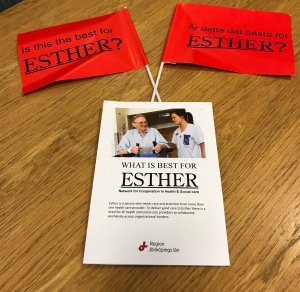
One of the most inspirational people I met, (high praise indeed as everyone was inspirational!) was Patrick Blomqvist. Patrick is one of the patient supporters for the region, in fact I would say he is THE patient supporter. Patrick has in his own words been a “hostage” of the healthcare system over many years and particularly when the health services started to include patients in designing services. Much of this patient involvement was in a tick box way so organisations could say they had consulted with patients. Patrick would be the token, single patient representative and his views would be listened to but not necessarily heard. Perhaps the 2 most famous of Jonkoping’s co-produced and patient led projects are self haemodialysis for patients with kidney failure and the Esther programme.
Self Dialysis Unit

For many health professionals the thought of letting patients have responsibility for such a complex, life saving treatment may sound the worst idea in the world but for Jonkoping that is exactly what they have done; with international recognition following. Supporting patients to help themselves has not only reduced their physical side effects but has improved infection rates and increased both staff and patient satisfaction. This all began by a person who wasn’t prepared to just be a condition and a nurse who felt that they had permission to think about the care they provided in a different way by seeing the patient as a person and a partner in their care.


“Person centred care is to see and meet the whole person. The person’s story is the starting point for the partnership, joint planning and mutual respect for each other knowledge” Patrick Blomqvist, Patient Supporter
Esther

No one would argue; that as health professionals we all believe that we are doing our best for our patients, but often we do this in isolation of each other and most importantly without real consideration of whether it is the best for the patient and what the patient wants. Often patients feel they are lost in the system.


The Esther programme has trained Esther coaches around the world to think differently about ensuring the patient is at the centre of the care, by training them in person centred care, quality improvement techniques and systems thinking. The programme encourages them to think about the actions in the system that go on to the left and the right of their intervention to make the system interlock and work as a system, reduce the repetition and the permission to redesign with the patient and for the patient. The programme is so successful there is an annual Esther Day in Sweden and the programme has been replicated across the world.


5. Always learning, always curious

The Qulturum collaborates with various organisations, perhaps the 2 most high profile being the Institute for Healthcare Improvement (IHI) and the Dartmouth Clinical Microsystems Academy. These critical friends help to support a culture of innovation and constant questioning that allows the Qulturum to develop its own message that, although influenced by many different areas of study and knowledge is synthesised into its own.

I was surprised by the curiosity that the people I met showed to the work we are doing and as much as I wanted to learn from them they were keen that I shared my work in the hope that they could learn from some of our good practice. This curiosity wasn’t confined to my work though. They have renamed the study tours to co-learning visits as they feel they learn as much from their visitors as their visitors do from them.

This curiosity and learning extends out from public services that the region has responsibility for to commercial organisations to understand what can translate to the services that the region are responsible for. Everyone at the Qulturum was deservedly proud of the work and the difference their individual work programmes made and the work of the Qulturum as a whole. They were also very humble and felt that even though they had achieved much there was still lots to do and lots to learn.


6. Measure, measure, measure!

Measurement is nearly always one of the parts of improvement work that people dislike the most but it is essential as without it; how do you know you have improved. I know it is one of the aspects of improvement I struggle to engage people with as it is often seen as lots of numbers and graphs. One of the things I learnt in Jonkoping was that we need to pay more attention to making people measurement and data literate. Also that as we do with clinical information we should alter the way in which the data is presented depending on the audience that will be receiving it. Often we don’t ask people what information they want so they can understand if a change is an improvement. We need to move away from data for management, the NHS is awash with data but very little of it is used for improvement, this is a place we need to go to understand fully what works and what doesn’t.

7. Quality improvement is in their DNA

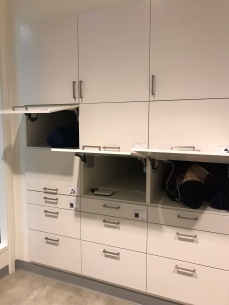
Quality improvement science teaching runs through all the education programmes. They have made quality improvement the method of change, their organising principle and business planning strategy. As part of leadership programmes people have to complete QI projects, patient supporters are taught quality improvement, Esther coaches are taught quality improvement, patient safety improvements are rooted in quality improvement science. Quality improvement is taught in simulation and is practiced by those who lead the simulation centre by always looking at better ways of delivering the training and better ways of storing all their kit – I can’t imagine anyone else has a storage system for the simulation mannequins that is quite the same, it looks very similar to a mortuary fridge but includes all the connections for keeping the mannequins “alive”, truly unique and a testament to their quality improvement ethos.


Data collection and understanding data is imperative as part of any change that anyone wants to make – you have to be able to see the journey that has been made. The expectations on anyone in a leadership position at any level is that they will increase capability and capacity in their sphere of influence and the quality improvement knowledge and skills are just as important as the technical and clinical skills of a role.
Final thoughts

It was a packed two days and these reflections only give a sense of the learning and sharing I was fortunate enough to participate in. The overwhelming take-home message was, don’t be afraid to try something that might not be what everyone expects, but with that make sure you co-create this with those people who it directly affects, both staff and patients, quality improvement should be the organising principle of all you do. Think more widely and creatively about what data for improvement is and how to make sure it is displayed and explained in a way that connects with the audience.

The answer to the question, Has Sweden got more to share than Ikea and Abba? The answer is a resounding yes.

I do think there are some parallels between the solutions that Ikea have developed – particularly innovative space-saving solutions and the solutions that Jonkoping Region have developed. Agnetha Faltskog was born in Jonkoping and as a founding member of ABBA has given many of us joy; and joy in work is one of the key elements of Jonkoping’s strategy. I think innovation and joy are in the country’s DNA, not just Jonkoping’s.

I would like to express my sincere and heartfelt thanks to everyone at the Qulturum who kindly and willing shared their time, knowledge and learning with me. It will be well used!


Feel free to share your thoughts with Caroline on Twitter via @Cargreenhalgh or via @AQuA_NHS. For more information about AQuA's Leadership for Improvement Fellows, please visit our website.

This blog was originally published on Caroline's Quality Improvement Journey blog.